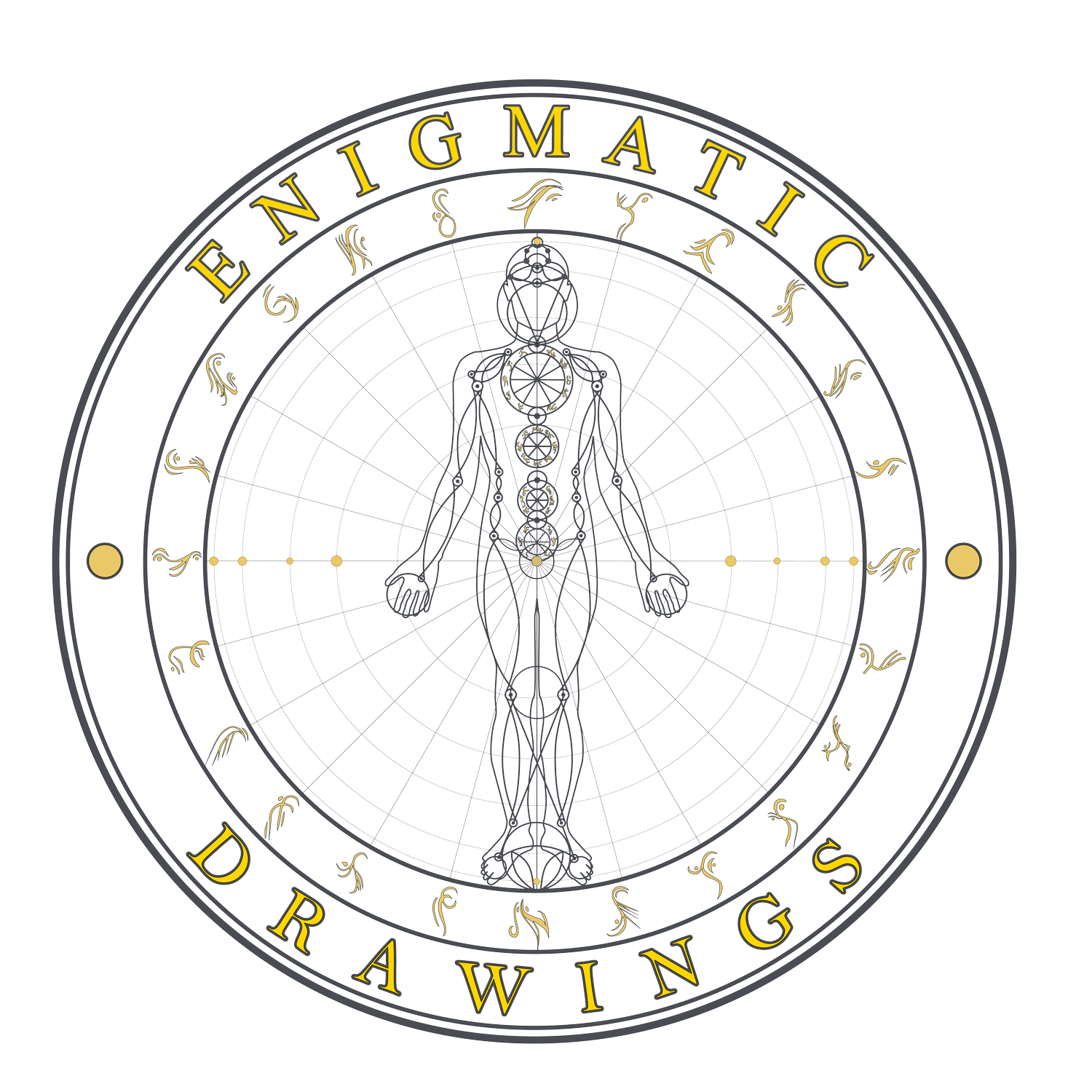
First Series Genesis — 18 Sequential Drawings
Drawing: #11 of 18 / Date: 16 August 2001
Genesis #11 - Black on Cream
Genesis #11 - Blue on White
-
Drawing ID: Genesis #11 of 18
Series: First Series — Genesis
Date: 16 August 2001One-line summary:
A reconstituted cosmic-human blueprint in which a central frontal figure is mapped as a chakra-bearing, geometrically ordered body flanked by bilateral encyclopedic panels of cosmic correspondences.Observed:
Genesis #11 presents a single frontal human figure standing at the centre of a highly structured vertical composition. The figure is anatomically simplified but clearly human, with head, torso, arms, hands, pelvis, legs, and feet visible. A strong vertical axis runs through the body, marked by multiple circular nodes aligned from above the head down through the chest, abdomen, pelvis, and into the lower base structure. Around the head is a large halo-like oval or aureole, while above the head rises a complex geometric crown or funnel-like structure culminating in a small eye-like apex. The figure is overlaid with geometric lines, triangular relations, circular nodes, and field-like structures. To the left and right of the central body are two large bilateral panel systems composed of rows of script-filled circles and repeated wave-like or looping line fields. Horizontal grid lines run across the full composition, visually aligning the side-panel circles with levels of the central body. Additional larger circular devices or mandalas appear near the figure’s hands and lower body. The whole image is enclosed within a broad oval or elongated field, with upper and lower arc-like structures completing the vertical cosmogram.Structural Analysis:
The drawing is governed by bilateral symmetry, a strong central vertical axis, and a left-right correspondence system. The body is no longer isolated inside cosmic space; it is positioned as the integrating interface between two enormous side panels of symbolic information. The horizontal lines create levels or bands, making the image function like a correspondence table as much as a spiritual diagram. The upper crown geometry, central chakra axis, bilateral wings or panels, and lower foundation structure give Genesis #11 the feel of an operational blueprint or technical cosmogram rather than a single contemplative image.Symbolic Elements:
The central body suggests re-embodiment after dissolution. The chakra-like nodes imply a fully activated subtle-body system. The bilateral side panels suggest cosmic catalogues, knowledge fields, or polar libraries of symbolic information. The halo and apex eye-like structure imply witness-consciousness crowned by higher perception. The geometric overlays indicate that the body is not merely biological but mathematically templated. The lower base mandala and vertical root structures suggest grounding, embodiment, and transmission into material reality.Controlled Interpretation:
Genesis #11 can be read as a human-cosmic operating diagram: the body as a sacred interface through which cosmic principles, symbolic systems, and energetic centres are mapped into practical correspondence.Series Context:
Genesis #11 follows Genesis #10’s dissolution into pure cosmic multiplicity by returning the human figure — but not in naïve form. The human reappears as a reconstructed system: ordered, indexed, and embedded within a larger network of distributed symbolic knowledge. It is one of the clearest “reconstitution” drawings in the Genesis sequence. -
Genesis #11 is one of the most important threshold works in the Genesis sequence because it marks the return of the human after the human has already disappeared. That point matters. Genesis #10 dissolved the witness into a vast non-anthropomorphic cosmic field. Genesis #11 brings the body back, but it is not the same body that appeared earlier in the series. It is no longer simply an embodied person, a transparent vessel, or a mandala-centred subtle anatomy. It is a reassembled figure carrying the memory of dissolution and now functioning as an interface between body, geometry, and encyclopedic cosmological knowledge.
The first thing that distinguishes Genesis #11 is the bilateral panel system. On the left and right of the central body are dense vertical arrays of circles, each apparently filled with script, arranged in rows and aligned across the whole composition. This is what makes Genesis #11 different from every previous Genesis drawing up to this point. Earlier works had circles, script, mandalas, and cosmic catalogues, but here the catalogue becomes architecturally explicit. The side panels behave like libraries, atlases, databases, or correspondence banks. They give the drawing an informational dimension that is much more overt than before.
The horizontal lines crossing from left edge to right edge are what make those side panels function structurally rather than decoratively. They create alignment bands that visually link the circles in the side panels to the body zones of the central figure. This turns the composition into a system of levels. The image no longer simply places a human being inside a cosmic field. It arranges body, symbol, and surrounding information into a coordinated matrix. That is why Genesis #11 feels less like a contemplative image and more like a working schema or operational chart.
The central figure remains indispensable to that effect. It is frontal, upright, and clearly human, but it is no longer just a witnessing presence. It is fully mapped. The strong vertical chain of circular nodes running through the body gives the drawing its most explicit subtle-body statement to date. Those nodes align very strongly with a chakra-like sequence from crown to base, making the body feel like a channel rather than a solid organism. This verticality is one of the work’s main stabilizing forces. It turns the body into an axis mundi — a living spine between upper and lower orders. The uploaded source material repeatedly identifies this as one of the strongest concrete correspondences in the drawing, especially through the seven-node vertical arrangement.
The crown structure above the head intensifies that reading. It gives the upper body a funnelled, haloed, almost architectural quality, as though consciousness is not simply located in the head but is entering, exiting, or transmitting through a higher geometric apparatus. The small eye-like apex above the crown reinforces this. It suggests a point of overseeing witness, higher perception, or supra-personal intelligence positioned above the reconstituted body. This is one reason Genesis #11 feels less like a human portrait and more like a body-as-interface image. The figure is not merely alive; it is connected.
The geometric overlays across the body are also significant. Triangles, arcs, vesica-like forms, and lattice structures make the figure appear mathematically templated. The body is not simply drawn; it is measured, crossed, and architecturally integrated. This brings Genesis #11 into strong relationship with sacred geometry, subtle anatomy, and correspondence diagrams across multiple traditions. But the drawing never collapses into one borrowed system. Instead, it synthesizes them into a single image logic: the body as precise carrier of a larger order.
The upper and lower circular frames strengthen that logic further. They produce a strong “as above, so below” effect, visually linking crown and foundation, upper mandala and lower base, heaven and root. The human figure is therefore suspended between two larger poles while still holding the central line. This gives the work a very powerful vertical drama. The body becomes the mediator between upper and lower worlds while the side panels hold the distributed archive of related forms.
From a systems perspective, Genesis #11 is one of the clearest drawings in the series for the idea of indexed correspondences. The side panels read like arrays, lookup tables, code libraries, or symbolic memory banks. The horizontal lines read like routing logic. The chakra axis reads like the primary bus or main transmission channel. The central figure reads like the active interface. That is a modern systems-language description, but the visual evidence supports it unusually well. The drawing feels ancient and futuristic at once. It behaves like a mystical chart and an information architecture simultaneously.
This is why Genesis #11 also carries such strong cross-traditional resonance. It can be approached through chakra diagrams, Kabbalistic pillar structures, Hermetic “as above, so below” correspondences, mandala architecture, grimoire-style body cosmograms, and sacred geometry traditions that place the human being between cosmic orders. The side panels make that multi-tradition synthesis particularly clear, because they turn what might otherwise have remained symbolic atmosphere into explicit relational structure. The body is not merely in a cosmos; it is mapped against a two-sided field of corresponding symbolic units.
Within the Genesis sequence, Genesis #11 functions as a post-dissolution reconstruction. Genesis #10 moved into a non-human, total-field architecture. Genesis #11 then returns the human, but now as a structured node inside a much deeper informational order. This is why the drawing feels like gnosis rather than simple embodiment. The human being returns carrying pattern. Consciousness is no longer just witnessing the cosmos, or dissolving into it. It is shown as an instrument through which distributed cosmic knowledge can be aligned.
That is the deeper significance of Genesis #11. It is not only a body with chakras and symbolic side-panels. It is a blueprint for the human as correspondence system. The body becomes the place where cosmology, subtle anatomy, symbolic indexing, geometry, and transmission meet. In the Genesis sequence, that makes Genesis #11 one of the clearest statements that the human is not separate from the cosmos, but is a readable interface within it.
Selected works within this series are also available in alternative colour renderings and, in some cases, as sectional derivative formats. See “Derivatives, Colour Variants, and Format” on the main Drawing Analysis page.
-
Genesis #11 feels like the moment the series stops showing the human being as just a symbol and starts showing the human being as a complete system.
At the centre is a standing human figure with a clear line of circular centres running up the body. That already makes the work feel connected to chakra or energy-body ideas. But the drawing goes much further than that. On both sides of the figure are huge curved panels filled with many circles containing script. These do not feel decorative. They feel like a giant symbolic reference system arranged around the body.
That is what makes Genesis #11 so distinctive. The body is not floating in space. It is positioned between two banks of information. Horizontal lines run across the whole composition, linking the side panels back to the body at different levels. So the image starts to feel like a chart, map, or blueprint rather than simply a spiritual drawing.
The head area is especially important. There is a halo-like enclosure around it, and above it a more elaborate crown or funnel-shaped structure ending in a small eye-like apex. This makes the upper part of the drawing feel like a zone of higher perception or transmission. The body below it then looks like the structure through which that higher order is grounded.
The lower circles and base structures matter too because they stop the drawing from feeling top-heavy or purely mystical. They give it root and foundation. The whole image therefore works vertically from above to below, while also spreading sideways through the two panel systems.
A simple way to understand Genesis #11 is this: it is a drawing of the human being as a living interface. The body is shown as something that links centres of awareness, geometric order, and a much larger field of symbolic information.
That is why the drawing feels so consequential in the series. After the total cosmic field of Genesis #10, Genesis #11 brings the human back — but brings it back transformed. The person is no longer just in the universe. The person has become a structured access point into it.
Drawing Analysis